
Most businesses arrive at technology decisions reactively. A system breaks. A competitor ships a feature that clients are now asking for. A key hire joins and says "we really should be on the cloud." And so a decision gets made — quickly, under pressure, with incomplete information — and everyone moves on.
This pattern is how organisations accumulate technical debt, end up with mismatched systems that don't talk to each other, and find themselves with IT budgets that grow every year without producing visible results. Not from bad intentions. From the absence of a plan.
A technology roadmap is that plan. And in our work across dozens of businesses at ZyoraTech, the single most consistent difference between companies that use technology well and those that don't is whether they have one.
What a technology roadmap actually is
A technology roadmap is a strategic document that aligns your technology decisions to your business objectives. It maps what technology your organisation needs, why you need it, in what sequence, at what approximate cost, and over what timeframe — typically 12 to 36 months.
It is not a list of software your IT team wants to buy. It is not a vendor comparison sheet. And it is not a vague ambition to "modernise" or "go digital." Those things might appear in a roadmap as inputs or outputs, but they are not the roadmap itself.
The key word is alignment. A technology roadmap that isn't directly tied to where the business is trying to go over the next two to three years is just a wish list. The value comes from answering the question: given what this business needs to achieve, which technology investments will have the most impact, in what order, and why?
Why most businesses don't have one
The honest answer is that building a proper technology roadmap requires doing two things that organisations find uncomfortable: thinking clearly about the future, and making explicit trade-offs in the present.
Thinking about the future is hard for operational businesses. The people who know the technology best are usually the ones most buried in day-to-day delivery. They don't have time to step back. And the people who have time to think strategically often don't have enough technical depth to evaluate options meaningfully.
Making trade-offs is uncomfortable because it requires saying no — at least for now. A roadmap that tries to do everything simultaneously isn't a roadmap, it's a backlog. Real prioritisation means accepting that some things won't happen this year, and being explicit about that.
The result is that most organisations operate in a permanent state of reactive decision-making, occasionally punctuated by large, poorly scoped projects that run over time and budget because the context and sequencing weren't properly thought through before the work began.
The pattern is well-documented. Organisations that make technology decisions reactively consistently spend more than planned, deliver later than expected, and find a growing share of their IT budget consumed by maintaining overdue legacy infrastructure — leaving less available for the investments that would actually move the business forward. A documented strategy doesn't eliminate these problems, but it makes them manageable. Decisions that would otherwise be made under pressure, with incomplete information, get made in advance — when there is still time to think them through properly.
What a useful technology roadmap contains
There is no universal template, but a roadmap that works in practice typically has four components:
A current state assessment. An honest inventory of what you have today — systems, infrastructure, data flows, integrations, and technical debt. You cannot plan where you're going without being clear about where you are. This part is often uncomfortable, because it surfaces problems that have been quietly ignored.
Business objectives. A clear statement of where the business is trying to go. Not technology goals — business goals. Growth targets, new markets, operational efficiency targets, compliance requirements, product expansion plans. The technology roadmap exists to serve these objectives, not the other way around.
Technology initiatives, sequenced. The specific projects and investments needed to move from current state to desired state, ordered by dependency and priority. Some things must happen before others can. Some things are urgent. Some are important but not urgent. A roadmap makes this explicit rather than leaving it to be worked out under pressure.
Governance and review cadence. A roadmap is not a static document. Business conditions change. Technology options evolve. The roadmap needs scheduled review points — typically quarterly — where progress is assessed and priorities are adjusted if needed. Without this, roadmaps become shelfware within six months.
A practical framework for building yours
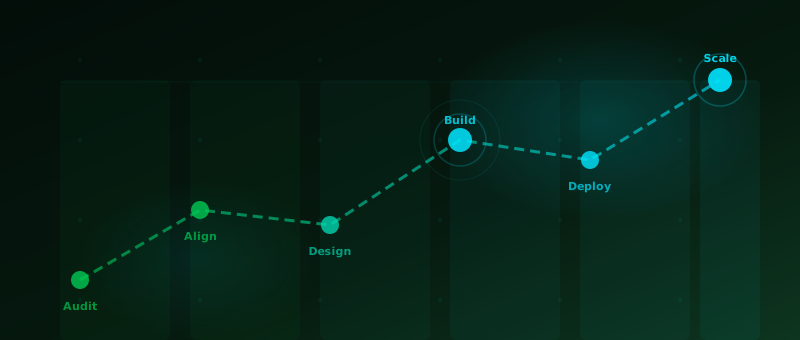
Here is the approach we use when helping clients build technology roadmaps from scratch. It can be adapted for organisations of any size — the principles are the same whether you have five people or five hundred.
-
01
Audit your current technology landscape Catalogue every system, tool, and platform the business currently uses. Document how they connect, where data flows, what works, and what causes regular frustration or manual workaround. Do not skip this step and do not underestimate it — most businesses discover they have more systems than they realised, with more interdependencies than anyone knew.
-
02
Define your business objectives for the next 24 months Work with business leadership — not IT — to articulate where the company is trying to go. What does success look like in two years? What are the biggest operational constraints on growth? What would need to be true about your technology for those goals to be achievable? Write these down in plain language.
-
03
Identify the gaps Map your current state against your future objectives. Where are the gaps? What technology capabilities do you need that you don't currently have? What existing systems will become a constraint as you grow? What technical debt is actively costing you time and money right now? This analysis is the core of the roadmap — everything else follows from it.
-
04
Define and sequence your initiatives Turn the gaps into specific initiatives — scoped projects or investments with clear outcomes. Then sequence them. Some will have hard dependencies (you cannot build X until Y exists). Others are a judgment call about priority. Be explicit about why initiatives are sequenced the way they are. That reasoning will be important when circumstances change and priorities need to be reconsidered.
-
05
Estimate, resource, and assign ownership For each initiative, attach a rough cost and effort estimate, assign ownership to a named person or team, and identify external dependencies. Roadmaps without ownership are aspirational documents. Roadmaps with clear ownership become execution plans.
-
06
Schedule quarterly reviews Put the review dates in the calendar before you finish building the roadmap. Every quarter, the roadmap owner presents progress against plan, flags changes in business context or priorities, and updates the document accordingly. The roadmap should feel current at all times — if it starts to feel stale, the review cadence needs to increase.
The mistakes that make roadmaps fail
We have seen roadmaps built with good intentions that didn't survive contact with reality. The failure modes are consistent enough that they are worth naming directly.
Attempting too much at once. The most common mistake. The roadmap becomes a comprehensive list of every technology improvement anyone can think of, all marked as high priority. This is not prioritisation — it is the absence of prioritisation dressed up as a plan. A roadmap with twenty high-priority initiatives is not twenty times better than one with five. It is functionally identical to having no roadmap, because no one knows where to actually focus.
Building it in IT, not with the business. A technology roadmap built solely by the technology team without meaningful input from business leadership tends to optimise for technical cleanliness rather than business outcomes. Technology should be in service of the business. That relationship needs to be reflected in how the roadmap is built, not just what it says.
Treating it as a one-time exercise. Organisations sometimes invest significant effort in building a roadmap, present it to leadership, and then file it away. Six months later, the business has moved on but the roadmap hasn't. A roadmap that isn't maintained is worse than no roadmap, because it creates a false sense of having a plan while the organisation continues to make reactive decisions.
Ignoring technical debt. Technical debt — the accumulated cost of shortcuts, legacy systems, and deferred maintenance — is usually invisible until it becomes a crisis. Roadmaps that only plan for new capabilities and ignore the underlying debt tend to run into serious problems around the 12–18 month mark, when the debt becomes a genuine constraint on everything else.
The honest summary: a technology roadmap is only as valuable as the discipline applied to maintaining and executing it. Building it is the beginning of the process, not the end. The organisations that get real value from roadmaps are those that treat them as living strategic tools rather than annual exercises.
When to bring in outside help
There are situations where building a technology roadmap internally is the right approach. If your leadership team has strong technical depth, if you have capacity to run a proper audit and planning process, and if you have the objectivity to make hard trade-off decisions about your own systems — you can do this yourselves.
But in practice, most businesses find that bringing in an external partner for at least the audit and gap analysis phase produces better results. The reasons are mostly about objectivity. It is difficult to honestly assess systems that your team built or chose. It is difficult to surface technical debt that has been quietly ignored for years. And it is difficult to have frank internal conversations about technology strategy when the people in the room are also the people whose past decisions are being evaluated.
An external technology partner can also bring pattern recognition from other clients and industries. Having worked across a range of organisations, they can accelerate the planning process considerably and reduce the risk of building a roadmap around assumptions that turn out to be wrong — a risk that is higher than most internal teams expect, precisely because the assumptions are invisible to the people holding them.
If you work with an external partner for roadmap development, the output should be fully owned by your organisation. A good technology partner builds your capability to manage and evolve the roadmap yourselves — they shouldn't be a permanent dependency for it.
The cost of not having one
The clearest way to understand the value of a technology roadmap is to look at what organisations typically spend in its absence. Emergency fixes to systems that should have been migrated two years ago. Integration projects that are unexpectedly expensive because the underlying architecture was never designed for them. Talent lost because the developer environment is too frustrating to work in. Compliance costs from systems that didn't keep pace with regulatory requirements. Security incidents from infrastructure that was overdue for replacement.
These costs are real. They are also largely invisible until they land, which is why they are so easy to postpone addressing. A technology roadmap makes them visible in advance — when they can be planned, resourced, and addressed in a controlled way rather than as a crisis.
At some point, every business that has been operating without a technology roadmap reaches a moment where the accumulated cost of not having one becomes undeniable — usually in the form of a project that costs three times what it should have, or a system failure that could have been prevented, or a competitor who moves faster because their infrastructure lets them. Building a roadmap before that moment is considerably less expensive than building one after it.